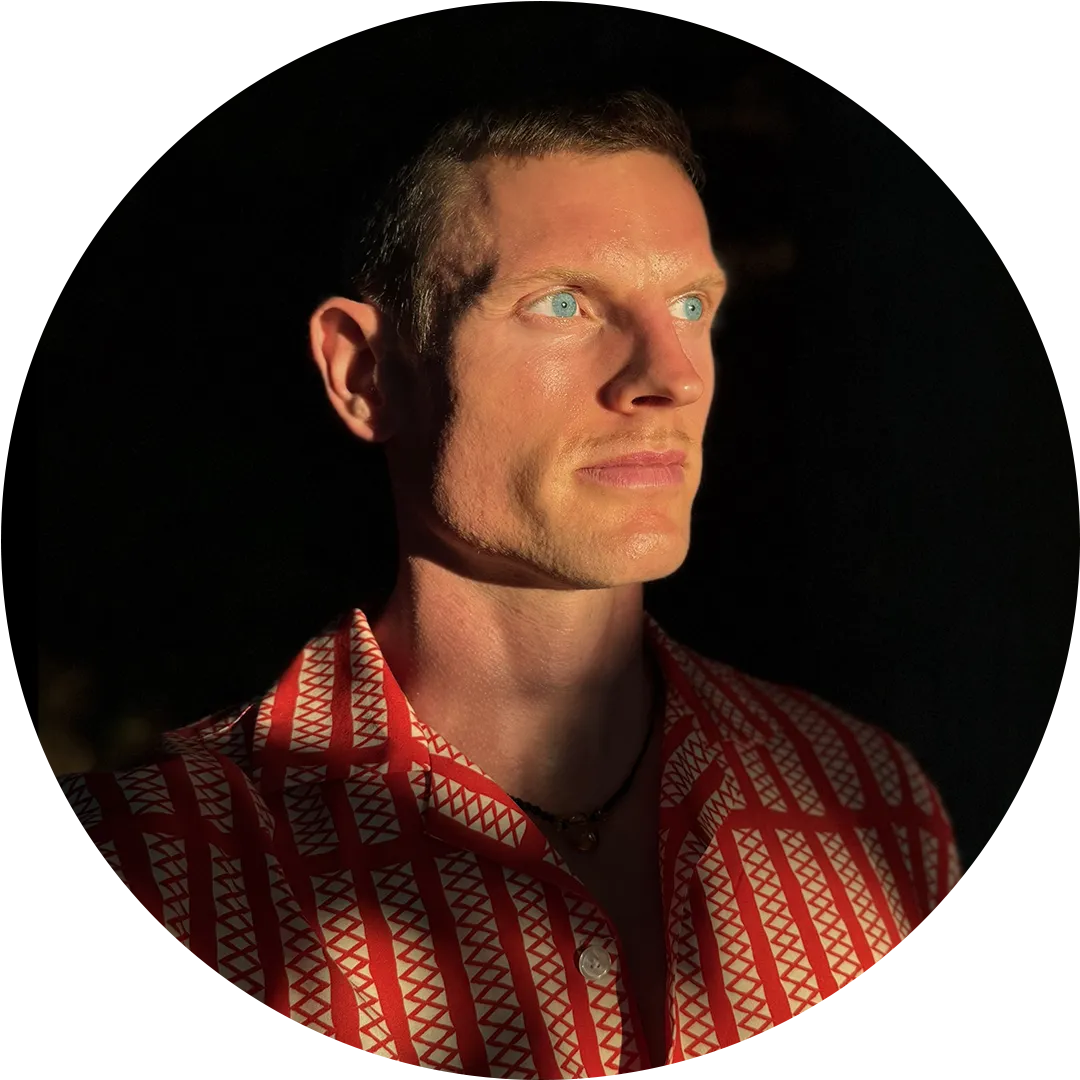
There is this guy. His name is Todd, and he is a millionaire.
(Names have been changed to protect the not so innocent)
Todd is staring straight through your screen. He looks profound. Or deeply serious. Or maybe he just hasn’t slept because he’s on day 42 of monk mode. He presses his hands together under his chin, fingertips resting gently on the neckline of a $300 unbranded beige t-shirt. On the minimalist oak desk beside him, purposefully placed just out of focus, sits a ceramic mug of ceremonial-grade matcha.
Todd leans into the microphone, drops his voice into a calm, authoritative, low-BPM rhythm, and begins to speak.
“The average person is trapped in the matrix of specialized labor. If you want to enter the top 1%, you don’t need a job. You need leverage. You don’t need to pick a niche. You just need to monetize your multi-passionate consciousness. Build a personal brand, synthesize your curiosities, and achieve ultimate self-actualization.”
It sounds intoxicating.
You watch this while eating a lukewarm sandwich at your desk, and you are hooked. Because Todd isn’t screaming at you to trade crypto. He’s looking directly into your soul and telling you that your ability to focus is a superpower. He’s telling you that your random obsession with stoicism, analog photography, and gut health is the foundation of a media empire.
Todd claims that thanks to his philosophy, he now works exactly two hours a day. (We will temporarily ignore the fact that feeding his newsletter funnels, managing his Discord, and filming high-contrast reels actually takes him 11 hours a day and a minor caffeine addiction.)
There is nothing really special about Todd. He is just very articulate. The promise is that everyone can do this. He makes you believe the only thing you have to do is be yourself on the internet. And if you buy his $997 course, you too can exit the matrix, transcend the 9-to-5, and build a successful creator business.
Todd is the hero of the modern creator economy. He is also a symptom of why the creator economy is currently broken.
The Creator Economy is Run by Delusional Optimists
Here is the thing about Todd. Todd isn’t lying to you.
He actually believes in his course. You aren’t buying a scam. He gives you an impeccably designed blueprint. It’s the equivalent of a NASA-grade, titanium water-purification filter. It works perfectly. Todd uses it every day to turn his thoughts into pure, liquid gold.
But what Todd forgets to mention is that a water filter only works if you have water. He already had a half-million Twitter followers when he used his blueprint in 2019.
He sold you the water filter. But you live in the desert.
You hook Todd’s system up to your Substack of 42 subscribers, turn the crank, and absolutely nothing comes out.
This is where the psychological violence of the creator economy begins. Because when you buy a high-end system from a very smart guy and it fails... you don’t blame the system. You blame yourself.
You think you didn’t synthesize your curiosities well enough or you haven’t used the correct writing framework.
You never stop to look at the unromantic math:
97% of Substack creators earn less than $1,000/month from their newsletter
Todd doesn’t like the math because it would mean he has to admit that it was more luck than his pure genius. So Todd calls these people low-agency.
Nobody is in charge of this whole thing. That’s what makes it so hard to see. The creator economy is not a pyramid scheme run by malicious elite. It’s a virus. A self-replicating idea that feeds on our need for status, freedom, and meaning, and rewards the people at the top for keeping the dream alive.
The system is designed to flow the water directly to the top. And Todd is working to keep the water flowing.
The whole industry only works if there are enough delusional optimists buying water filters and don't realize they are standing in a dessert.
By now there is a natural urge to call everyone a grifter and decide that building a Substack doesn’t make sense. It feels like defending oil cartels in a class-action lawsuit. Or dealing fentanyl.
Before you start deleting your Substack, let’s look at the alternative.
The Myth of the Million Dollars
The reason we fall for the Todds of the creator economy is simpler than we'd like to admit. Todd didn't invent a dream. He just packaged one we already had.
“Build a personal brand and become a millionaire doing what you love.”
That sounds great. But who says I want to become a millionaire? When we think about having a million, we are really fantasizing about the freedom from problems and autonomy. What we don’t see is that there is no life without problems. No matter how many zeros your bank statement shows.
I guarantee you that 99% of people do not actually want to be millionaires. They just like the idea of the money, but not what it requires to get there.
What you actually want is the ability to stop working at 3:00 PM on a Tuesday, close your laptop, and go for a walk in the sun. Or to meet with your friends… or just to enjoy your life.
You don’t need a million dollars for that kind of life.
With a hundred thousand a year you can eat well, travel, drink the fancy coffee, invest the rest, and leave your desk when the weather is good without asking anyone's permission. Most people who've actually made a million dollars are still at their desks at nine in the evening trying to figure out how to make two million. The number grows. The Tuesday afternoon walk keeps getting postponed.
You want to become a Sovereign Creator. Most people hear “sovereign” and think of yachts and financial freedom. But psychological sovereignty is infinitely more important. You have to define what success looks like for you. How much is enough?
If you don’t define it, you will accidentally adopt the definition set by people who do not care if you are happy.
The Strategy of Art
There is another point that stinks for Todd. The sobering statistics mean you are better off keeping your day job or freelance work. Savings would do the trick as well. Keep whatever is paying your rent. At least for now. The biggest mistake you can make is putting the pressure of survival on the thing you love.
Even shooting for $100k requires uncomfortable work and patience. So how do we ensure that even if you miss the financial target, you haven’t wasted two years of your life?
If you are reading this, you probably want to help people with your work. But you don’t help people by producing content. Nobody ever woke up saying “Man, I could really use some content right now.” Instead of creating content and becoming a slave to the algorithm, we are going to make art.
When I say art I don't mean you have to become DaVinci and paint the next Mona Lisa. Art is simply a way of being in the world.
Your first piece of art is yourself.
The act of creation forces you to get to the core of who you are, because you cannot make great art while pretending to be someone else. Art is an expression of who you are. You are constantly confronted with the question of why you are here.
That’s why art is really an existential response, a deep longing to transcends yourself. You don't just make the work. The work makes you. I like to think of art as way of sharing your gift with the world and in the process become a better person.
This can have a therapeutic effect where both the creator and the audience have an opportunity to heal. You share what you see in a way that makes someone else feel less alone. That leaves something real behind.
In the process of creating art you lose yourself and participate in a communion with the work. Instead of submitting to consistency you submit to devotion. You are answering something that comes from inside you and needs to exist regardless of whether anyone reads it.
With this mindset you can’t lose. Even if you don’t make single dollar you have developed a point of view that cannot be copied, a voice that is yours, and a relationship with your own creative capacity that no algorithm can take away.
Content decays. Art accumulates.
How To Actually Make a Living
Philosophy is beautiful. But philosophy does not pay the rent.
Forget the traditional metrics that Todd obsesses over. For the first six to twelve months your only job is to find ten people who genuinely care about what you’re making.
Not ten thousand. Ten.
Find ten people who trust you, respect you, and need what you have to say. Ten people who read everything you write. Who send it to one person because it changed their life. Who would genuinely miss you if you disappeared
Ten people who trust you are worth more than ten thousand who follow you for the dopamine.
From those ten, you will eventually learn what problem you actually solve, how your voice sounds, and what you have to offer that nobody else does. But you can only learn that from people who care, and you can only find people who care by shipping the work.
Right now, a familiar voice in your head is probably asking: Okay, but what is the exact acquisition strategy for the ten? How do I actually get them? What’s my niche?
Let me stop you right there.
You are looking for another blueprint. You are trying to overcomplicate the mechanics so you have an excuse to avoid doing the actual work. Asking “how” is the best friend of the sophisticated procrastinator.
You want the step-by-step plan to get your ten? Here it is:
Open a blank document (or one of the thirty in your drafts folder) and write something so uncomfortably honest that it makes your stomach hurt. Hit publish. And then you do it again next week.
Do that consistently for six months, and you will be ahead of 99% of the people on this platform. If you really did this for six months straight and you still feel completely lost, hit reply. I will personally refund you every single penny you paid to read this free email.
Somewhere in this process, whether or not the business works, you become someone who has done the hardest thing a creative person can do: You stopped planning and started becoming.
You didn't build a personal brand. You built a person.
Now, stop procrastinating and close this tab. Your blank page is waiting.
P.S. Everything in this article points to the same problem. You are trying to build something that looks like you without knowing what you actually look like.
I created The Archetype Navigator to help you with that. It’s a free and takes less than 5 minutes to uncover your natural pattern, so you can build a body of work that actually looks like you. It might save you years of trying to find your niche.